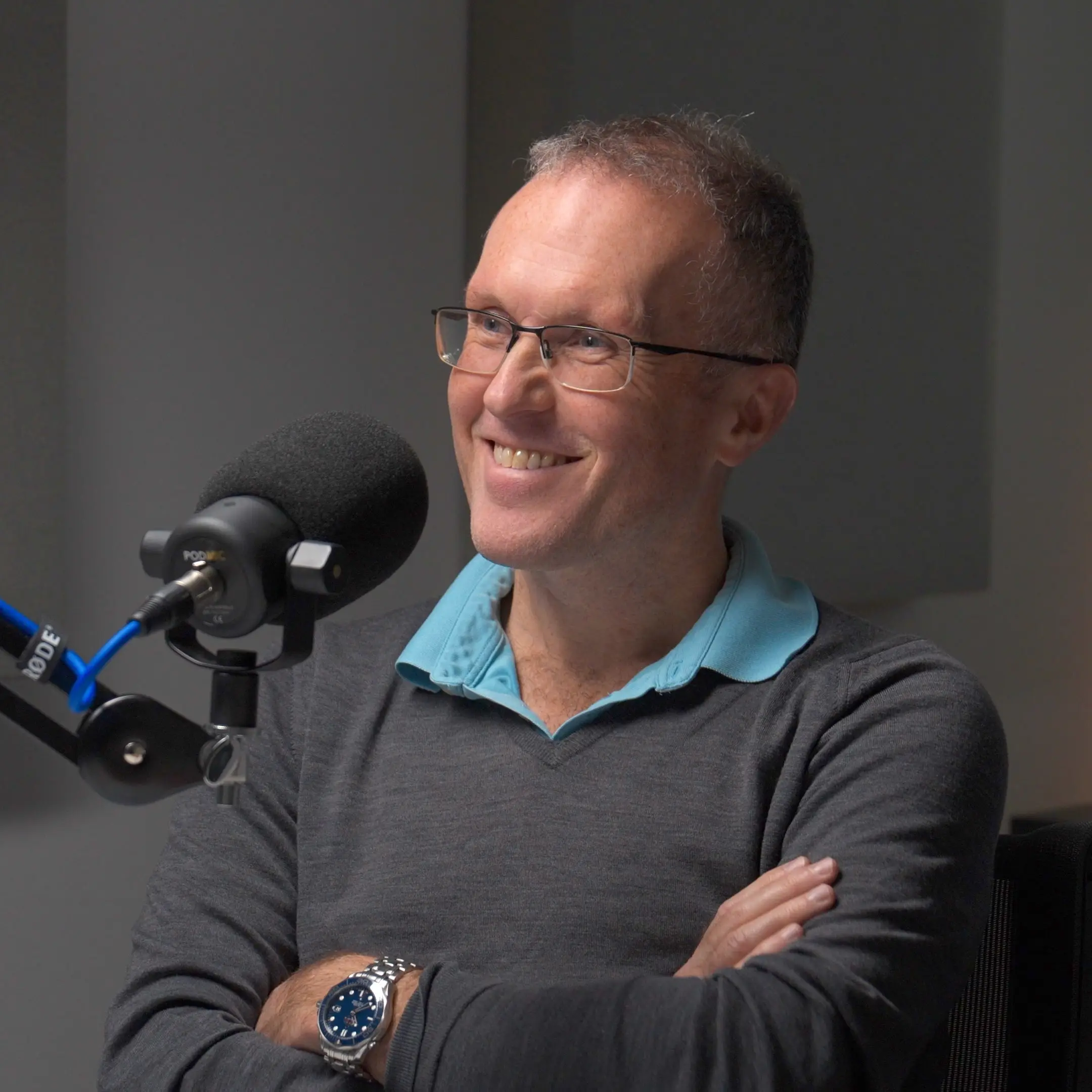
Healthcare Innovation When Lives Are at Stake


.png)
.png)

How does world-class science fail to become a scalable business — and what can founders do about it?
In this episode of Oxford+, host Susannah de Jager speaks with Benny Axt, Entrepreneur in Residence at Oxford Science Enterprises, about the complex relationship between healthcare technology and the systems it must operate within. They explore why healthcare's apparent inefficiency is often intentional constraint, how reimbursement models and regulatory pathways can make or break a company, and what UK health tech founders consistently underestimate about the US market.
Drawing on a recent BCG report highlighting a £20 billion annual opportunity if the UK strengthens its ability to translate research into real-world solutions, the conversation underscores why system fluency is not optional but essential. From the cultural transformation Benny led at DaVita across a dozen countries to the structural realities of NHS adoption and the perverse incentives within US oncology, this episode offers a candid and practical guide for founders, investors and anyone working at the intersection of innovation and healthcare delivery.
Benny Axt: Benny Axt is Entrepreneur in Residence in the Health Tech team at Oxford Science Enterprises (OSE), the largest university-affiliated investment company in the world and OSE's first EIR to join from the US. A seasoned healthcare strategist, operator and corporate development leader, Benny has spent over 15 years building healthcare businesses across six continents. Previously Vice President of Strategy at Dialogue Health Technologies Inc., he supported the company's US market entrance and helped grow it from a venture-backed startup through to IPO and acquisition. Before that, Benny held leadership roles at DaVita, a Fortune 500 healthcare provider, where his work included leading the privatisation of healthcare services in Saudi Arabia and building cultural infrastructure across more than a dozen countries. Benny holds an MBA and a Master of Health Care Delivery Science from Dartmouth College. In addition to his role in venture capital, he serves as a board advisor and healthcare consultant to leaders seeking guidance on strategy, operations and international expansion.
Susannah de Jager: Welcome to Oxford Plus the podcast focused on innovation around Oxford. We look at everything across the ecosystem, the institutions, the people, the technology. If you need to learn anything about Oxford, whether it's how to take a first step in through the door, or as an experienced investor wanting to go deeper, this is the podcast for you. Health technology innovation is as much about navigating complex systems as it is about breakthrough science and product design. From regulatory frameworks to reimbursement pathways, provider dynamics to global market access, understanding the systems can make or break a nascent company's success.
Today's guest is Benny Axt, Entrepreneur in Residence at Oxford Science Enterprises, where he works closely with health tech founders across the portfolio, helping them understand and navigate the realities of healthcare delivery and commercialisation around the world. Benny's experience spans healthcare systems globally with particular depth in the US where fragmented payer structures, regulatory requirements, and system complexity, pose unique challenges to innovation. He brings this expertise to Oxford, helping founders translate scientific potential into real world impact.
In this conversation, we'll explore how healthcare systems shape the fate of health tech companies. What founders often underestimate about system engagement and how Benny's global perspective adds value to the Oxford Science Enterprise's ecosystem and the innovators and founders it supports.
We'll talk about navigating complexity, building credibility with stakeholders and the practical lessons that early stage health tech teams need to succeed in markets that are often fragmented, demanding, and full of opportunity.
Benny, thank you so much for joining today. So I'm going to dive right in. From your perspective, and it's a broad one, what is the biggest misconception about the healthcare industry from the outside?
Benny Axt: It's a pleasure to be here with you today. I think the biggest misconception about healthcare is that it's inefficient because it's poorly managed or it's resistant to innovation. And in reality, healthcare is one of the most complex, highly regulated and risk sensitive sectors in the world, and it's just not optimised for speed. It's optimised for safety, equity, and long-term sustainability. What may look like friction from the outside of the system is often intentional constraint. In most industries, if you move fast and you break something, which is a common expression in startups, you fix it and you iterate. In healthcare, if you move fast and you break something, people can die.
One story that I would offer you when I joined Dialogue Health Technologies Inc., as a consultant years ago, they were an early stage venture backed company and they had a mental health product that was a misfit for the market. They lacked product market fit and they had a telemedicine product. They were trying to scale, and the pandemic was a massive tailwind, and so they were trying to get a contract in place with the largest insurance carrier in Canada, SunLife, and when the pandemic came, I was a consultant for the organisation and there was a flash RFP that was issued by SunLife and so they went to a few of the large telemedicine providers to seek support for a platform to cover four or five million lives across Canada.
There were a few companies that were in the mix for the RFP, Dialogue being one of them, and the initial response to the RFP was we want to go fast and we think that your competitor, we've seen their response. They're able to do this in a third of the time and so within several weeks we'll be up and running across Canada. All of our members will have access to the telemedicine platform and I think it took amazing ethics and real backbone organisationally to hit pause and to not pursue the tender as it was written and to actually communicate back to SunLife, that if we were to move that quickly, people really were at risk of injury or death.
We ended up winning that tender and I think it was a result of being laser focused on safety, equity and technology andgoing back to what I described as intentional constraint. Just being mindful that if you move too quickly, people do get hurt and so I think there's this healthy tension between urgency and responsibility that makes the industry both frustrating but also incredibly meaningful.
Susannah de Jager: That's very thought provoking in the best possible way because you do hear people complain. It's so easy to join in with a slightly negative stance on, oh, it should move faster and how ridiculous.
There's often this dynamic about tech or system. Is it the tech? Is it the system? Clearly there, there was a bit of both. How do you view when you are talking to a company for the first time, whether they should be building for the system, or whether sometimes the system needs to refine towards the tech?
Benny Axt: Yeah, I love the tension in the question. I think the framing assumes a binary and I think success is driven by the quality of the technology and also the system inwhich it operates and so I think it's both. I've seen world-class tech fail due to reimbursement misalignment. People don't understand how services get paid. I've seen modest tech scale successfully because it fits within a system. I've led M&A integrations where operating systems mattered more than product features, and I'm now supporting organisations that are really at the forefront of deep science and deep tech and I think that's where tech matters profoundly. The answer isn't, system versus tech. I think technology creates potential. I think the system determines realised value.
I've come to believe that technology determines the ceiling of a company's potential, but I think systems determine the floor and so you can have extraordinary technology, AI imaging, diagnostics, neurostimulation. But if it doesn't integrate within reimbursement models, within the regulatory framework of a healthcare system, within clinician workflows, things often break down because there's change management. You're trying to influence behaviour, regulatory frameworks, in all of these operational realities, things just won't scale. I think the biggest predictor of sustained success is whether the company understands the ecosystem in which they're operating.
One of the books I really love,was a professor of mine at Dartmouth, a guy called Ron Adner and so he wrote this ecosystem strategy book called The Wide Lens and there are some innovations which are just too early because the other actors or entities in the ecosystem are just not ready for the innovation to scale or succeed. So I think you need both, and I think there's healthy tension in each.
Susannah de Jager: And you are obviously now in this seat where you are speaking to, as you said, some of these amazing deep tech companies now in Oxford as your Advisory Entrepreneur in Residence role with OSE, Oxford Science Enterprises. Are you seeing things, and I won't ask you to call them out because that would be unfair, but are you seeing things that fit into that camp of, this is amazing, but no, the world's just not ready. The system's just not ready.
Benny Axt: Yeah, I have a great example. I see this many times, and especially in healthcare, where you have extraordinary science, but it doesn't automatically translate into a scalable commercial business. In my current role, I see a number of technologies that are genuinely impressive from an IP standpoint. When we, especially on the venture side, the venture capital side, start digging into the ecosystem in terms of who pays, who benefits, who needs to change behaviour, we sometimes find there isn't a clear economic buyer or the pain point isn't acute enough to drive adoption.
I often think about that as very sexy research or intellectual property that is looking for a problem to solve and I think that's the exact wrong way to think about how things can actually translate out of academia. I've also faced this in operating roles. So at dialogue I wore several hats. I was running strategy, corporate development, so mergers and acquisitions and innovation. And so I was often faced with, do we build something? Cause we had a full stack engineering team we could deploy. Do we buy something? I had investment bankers that I could stick on the case or do we partner in order to execute? I saw many instances in which technology was strong or ideas were strong, but integration risk or market size or strategic alignment within the ecosystem just didn't justify the investment.
In terms of what I've seen here, when I came to Oxford, I had four or five different thematic areas of focus. One of those is healthy ageing. There's a bifurcation there between, longevity as a science, and there's a bit of pseudoscience there, and there's some really interesting emerging opportunities. And I think the bifurcation is there are also companies focused on the pillars of lifestyle medicine. How do we live healthy, nutritious lives? How do we sleep more effectively? How do we take the preventative steps that are necessary? They're not mutually exclusive, but they're different.
One example of technology that I was looking at was in the age tech space and so the technology itself was very interesting. It was a mission-driven company. It had the right founding ethos. It really focused on healthy ageing at home, and it was through digital coordination and empowering caregivers to support people to live more gracefully in their homes. Conceptually, I believe healthy ageing at scale can absolutely be made safer and accessible and more affordable. Especially if we leverage the supportive ecosystem of people who are providing this care and they're not compensated for it.
When we stepped back and looked at the problem and really mapped the system, a few structural realities became clear. So first is that, and this is with a US lens, caregivers are really the fulcrum of the ageing system. So unpaid family caregivers, they represent hundreds of billions of dollars in invisible labour, and they already perform this quasi clinical function. Yet, we don't document them. We don't train them consistently. We don't reimburse them for what they're doing for society and so any age tech solution that ignores or sidelines caregivers increases friction and just struggles with widespread adoption. Interestingly, when I started to interview people who have ageing parents who are part of the sandwich generation, young kids, elderly parents, many of them expressed interest in a solution, but in a lack of willingness to actually pay.
What seemed like really interesting technology, from the outside, didn't stand up when you started to think about the economics of the system. There was this need to solve multiple complex economic problems in parallel and the existing system is just not there yet. Unfortunately we needed to say. No, and not necessarily to the category of healthy ageing, but it was a no, not yet, because those key pillars were just not in place.
Susannah de Jager: Really interesting. Have you seen much of a shift in some of these spaces post GLP-1? Because I think the statistic is that it's around 85% of them that are being paid for out of pocket. So it's behaving more like a consumer product than a typical health product.
Benny Axt: There are many challenges at play with the GLP-1. I think we are now seeing the potential to use GLP-1 for multiple indications of healthcare. So I was with a colleague, a friend, on Friday night and she's a demographer within the University of Oxford, and she was telling me that there's some very interesting work that's happening with dementia, with neurodegenerative diseases. We're seeing this potentially with smoking cessation. Obviously we're seeing it with weight loss. There are side effects withthe lack of muscle mass. So people are using this and then the drug companies, and recipients of the drug, need to also think about how do you retain strength. While it may appear as a panacea, there are some potentially negative consequences and I think about this, and once again, using the US lens. You have self-insured employers, which cover preponderance of the employee base in the United States. So in essence, they run their own actuarial tables. They are ensuring their own population of people. The question that they face is, do we put this in our own formulary? Do we give our employees access to GLP-1? We're seeing the weight loss benefit and so is there an economic case that we're going to see a decrease in some of the downstream healthcare related cost? I think with the high price of the drug, they're trying to wrap their heads around that.
Similarly, health insurance companies, if you go another angle, that are actually taking the risk for employees they also see a very high cost for the drug. And so I think that direct to consumer model becomes much more relevant. If you're watching the Super Bowl and all the commercials, the prevalence of Super Bowl ads directed at consumers, I've never seen anything like it.
I think there is a real fundamental shift in terms of do people pay out of pocket for the solution? Andwe'll start to see organic pull as more people pay out of pocket and then demand that their employers cover those costs. And so, especially for innovative benefit focused companies, I think it will be a key lever to either attract or retain talent going forward.
Susannah de Jager: Gosh, that's a fascinating thought. I'm sure you're right.
So we've spoken a bit, and it's obviously the largest global healthcare market about the US. But you have experience across a number of different healthcare systems. So what do you see as in common, and what are some of the key differentiators from your perspective?
Benny Axt: This is, I love this question, it's so interesting. So I've been very fortunate to work in healthcare systems on six continents, and I think there are four things that I see fairly consistently across systems.
So, number one is there is a significant unmet need. Going back to that healthy ageing thesis. Around the world, we're seeing an ageing populace and a dearth of caregivers. There's a shortage of clinicians and allied health professionals that provide the support. So in an age in which we are seeing the progression of AI and technology care is becoming much more extensible for populaces. So there's a huge push to try to do more to ensure that physician leaders, clinicians, are optimising and practising at the top of their licence. It's a bit of a trite expression, but what it means is they're optimising for what they're best at and if technology can supplement their skills, whether that's summarisation of a clinical note, to give them time to do what clinicians do best, which is develop interpersonal rapport, to really understand the holistic needs of their patients, then we're doing a service to society. So that's number one, that significant unmet need.
Number two for me is no matter where you are in the world, I think speed of decision making is really, Queen or King. I think it just reigns supreme. I think in startups this is very obvious, but even in large organisations, the ones that outperform are the ones that find ways to move quickly and avoid getting stuck in complexity.
Three for me is the clarity of the problem and the customer. And so understanding the pain point, and in healthcare, this is multifaceted. So it could be three legs to a stool or four legs to a chair. The three legs to the stool here in the UK are the patient, the provider, and the regulator because the payer is typically the NHS. The fourth one in the US would be the payer. I think it's really important to stay close to the needs of those constituents, and they're often misaligned. And so having crystal clarity in terms of the problem you're solving, and why it's important to the key constituent you're solving it for, is just paramount. You can feel very quickly whether the team has the right DNA to scale and whether they're aligned, accountable and focused on outcomes and I think that tends to matter much more than structure on paper.
Lastly, I think execution beats intent everywhere. There's great quotes about, King Mike Tyson saying everyone has a strategy until they get punched in the mouth and so very important to go into combat and to have that strategy. But the realities of the market will punch you and so being able to very quickly adapt and execute is really what separates the wheat from the chaff.
Susannah de Jager: In different settings, do you see different cultural responses to that sort of equivalent of being punched in the mouth?
Benny Axt: Culture matters a lot. I started my career when I finished my MBA. I was recruited into a leadership rotational programme with DaVita. There have been multiple business cases written, Harvard Business School, Stanford Business School cases, based upon the culture of the organisation. So there's lore there. It was a failing penny stock and they called him in. He was in his early forties at the time. He's called Kent Thiry, he was a partner at Bain, and they asked him to turn the company around operationally, and he said, I won't do it unless you give me the ability to transform the culture.
The board thought it was a strange request. They figured that it was going to be part and parcel with his goal. But he was very intentional about how he went about structuring that cultural element and so I can still from the dead of sleep, tell you what the core values of the company are, service excellence, integrity, team, continuous improvement, accountability, fulfilment, and fun. There's seven of them.
He would always espouse things like we are a community first and a company second and he would dress up as a three musketeer, and so he had his musketeers andhe would say one for all and people would respond all for one and so it was a call and response community he built. Very early on he appointed a Chief Wisdom officer to oversee learning and development in the organisation. So the first one was called Yoda. It sounds made up. When I came in as part of the Redwoods leadership programme, post MBA, I was assigned, as an executive mentor, the Chief Wisdom officer who's the third one, a guy called Dave Herman. He's been a mentor of mine for 15 years. I talked to this guy religiously. I got to see as he was helping build the scaffolding of DaVita's culture internationally.
The first year I was there, I was an operator in the Bay Area managing multi-site operations in California and then DaVita won the largest holistic outsourcing of healthcare service provision in the history of the Kingdom of Saudi Arabia. So we received overnight half of the end stage renal disease patient population, and I had done consulting work in the Middle East to privatise state on enterprises, and so I was called in to support the execution of this contract. I was one of the first expats on the ground helping to build the infrastructure in some instances, building new hospitals or clinics within existing hospitals, and other ones taking over Ministry of Health facilities.
So as you can imagine, as you know well, Susannah, living in the Middle East, the culture is very different than the West. When you take a very left-leaning liberal culture like DaVita, which is as far left as it gets, and then you bring it to an environment like Saudi Arabia, there are challenges, rifts and gaps to fill. I had the benefit of his tutelage, his mentorship, and so I was able to think about how to empower and identify people who are aligned with the culture of DaVita within individual facilities.
In Saudi Arabia, part of my task, at one point, I was running people services so I was the head of HR and I was recruiting physicians from Jordan and South Africa and all over the world, and the same with the nurses, and you had a very hierarchical culture. In medicine that tends to be the case anyway with the physician at the top of the pecking order and then you had the overlay of additional cultural sensitivity based on the fact that it was the Middle East. We had to work on how we would bring our core values to life in the local operating environment. We approached it with the philosophy of understanding the culture first and then adapting the core values of the organisation to ensure that they align with the culture.
The way that I went about this, we started in Saudi Arabia, by rolling out what they call the Wisdom Ambassador Programme. So finding those people who, in their heart, really embodied that DaVita culture and then empowering them with the right tools and resources to scale that culture within their facilities. So it was a very organic bottom up endeavour, which succeeded massively in Saudi Arabia, and then I was asked to build it across a dozen different countries, so Malaysia, India, Brazil, Columbia, all over Western Europe, Poland, Portugal, the Netherlands, and interestingly, in each culture, we would refine the approach.
So we took that methodical lens of understanding what is important to the people who live and work in this operating environment. Are there things that they find zany about Davida's culture? And if so, how do we make this adaptable for their reality? I think it's really important to step back, especially from healthcare where delivery is so localised, understand how things are landing and seek to adapt to make sure that your message resonates with the local population.
Susannah de Jager: And isn't it amazing because it sounds quite pioneering. In many ways it is, just to be clear. But it almost should be first principles of any meeting. See the person opposite you. Ask them some questions about their needs. Try and work out, in advance of the meeting ideally, what their perspectives might be that differ from your own. Basically take notice of the person opposite you rather than just being on transmit or project or making assumptions. So it seems complex and yet the principles that sit behind that should be at the core of, quite frankly, any business, let alone in healthcare.
Coming back to the US system, because it is, let's be honest, the target market for so many nascent companies in Oxford and beyond. What are the biggest misconceptions that founders you are talking to, day to day in your current role, have about the US?
Benny Axt: Yeah, it's great. I wrote an article recently for Founders and Funders in their substack that was focused on this issue, so very topical. I see it in four areas. It's easy to assume as an anglophone culture that things translate one to one. In terms of your last response, I couldn't agree with you more. You do your homework upfront. It should be first principles in terms of how we address other people and what we try to learn about them before we sit down with them. I think that's probably a testament to your global citizenship, Susannah, having lived and worked in a multitude of countries and just realising how diverse we are as a society. I think it's less intuitive to people who've never been out of their bubble. And so the United States, there's an abysmal rate in terms of, passports and people who've travelled outside the states and so I think culture really does matter.
In the US things, move very quickly and I think sometimes that may be it's appreciated here in the UK for sure. Many of the venture capitalists that I talk to wish that their portfolio companies were thinking more, about how you can innovate with velocity and how we can unlock capital andculture is one of the areas that is, important to be mindful of.
I think the second piece is the regulatory system, and this is changing. It's evolving very quickly. Hand in hand with regulation is also reimbursement. Just because you actually succeed at getting your device or your software as a medical device, for example.If you get it approved, it doesn't necessarily mean that you're going to instantaneously be reimbursed. Understanding that there's a pathway that needs to be walked. How do things get navigated effectively from a regulation perspective? Do you have what they call a predicate device that you can piggyback on to enter the market? Do you have to do a 510(k)? A De Novo clearance? The regulatory structure is key and then understanding once you get clearance, who's going to pay for this and why? Is it a rip and replace kind of solution? Are you expecting net new expenditure for whatever you're offering? So that crystal clarity from day one, I think is really key.
And then I think maybe the last one I would offer is that the US is an absolute quagmire. It is a $5.6 trillion healthcare system and the incentives are perverse and they're misaligned and for example, in the cancer space. So much of the expenditure in that space is based on drug, Keytruda, other pharmaceuticals that are first line. And if you look at an income statement for a medical oncologist operating a single centre in rural America, 75% of what that physician's making is based upon their drug spend. So they buy drugs from PBMs and they put a margin on the top and so I think there's a reticence to disrupt the economics, and so it really requires understanding what may be better for the patient, may not actually have the requisite reimbursement. Understanding where that friction exists, how you navigate it, and where you can align with the payment, I think is really key.
Susannah de Jager: It's true. I always find this a little bit depressing when I have it spelt out for me when I've interacted in my, advisory work with companies that are subject to these forces and yet we need to navigate it.
Just going back to something you said, replacement versus completely new. It feels to a lay person, like replacement is going to be an easier pathway. But do you see completely newcost centres growing up, for new developments?
Benny Axt: That's a really thoughtful question.
Susannah de Jager: Intuitively, it feels harder.
Benny Axt: I think there are many examples and I think that's what's really important about driving this paradigm shift within US healthcare. So cell and gene therapy is an example of that as just thinking back on that chemo example. I would love to see in 10 or 20 years time that a treatment which is designed for a single person is rolled out at scale so that we're not putting them on harmful oncolytics and they're highly toxic and so those are new cost centres. They're very expensive therapeutics. They require new infrastructure. They require the manufacturing of these therapies and so I see lots of opportunity there. And you see them with orphan diseases where, and especially true in the paediatric population, where we have very sick kids who don't have the chance to live long lives. There are fast tracked exceptions that are made for how we develop a drug, and so oftentimes that would be an example of a net new expenditure. Systemically, I think those are the right things societally to do and there is a very conflicted competing interest.
I think in contrast in the UK we have NICE and I think there's general societal buy-in and it's hard as a parent. You think about if your child has an illness, a serious illness, you go to the ends of the earth to support that child. And I think collectively in the UK we have a body that adjudicates decisionsfor treatment and determines quality adjusted life years and how much we as a society are willing to pay for a treatment.
In the US it's uncapped, it's different, right? So it's a macroeconomic question and it doesn't have an easy solution. But my hope in the future is that we see more precision medicine and it may be net new expenditure, but ultimately we'll put a lot of healthy years into the lifespan.
Susannah de Jager: It's tricky, right? You see companies across quite a wide spectrum. You've got completely nascent technology coming into the OSE portfolio. You've got much more developed companies there. At what point should a UK health tech company seriously start designing for these issues that we are discussing for us, reimbursement and procurement? It's part of your job specifically to get them to think about it. So how early are you getting in there, Benny?
Benny Axt: If you're serious about the US, you need to design it from day one. Not fully build for it. But understand how you'll get paid, who the buyer is, what evidence they'll require, how you'll build it, how you'll structure the team in order to win. Because if you wait too long, you don't just slow down, but you end up having to redesign the product and the evidence from scratch.
I often see sometimes a purgatory of these pilots that it's cyclical. They start and they try to scale across different NHS trusts. The systems are so different and so I think the UK is an amazing test bed. The US, many systems, many providers look at the UK with genuine admiration in terms of the longitudinal nature of data and so it's not always the cleanest data we have to curate the data. But since the mid forties, we've had this incredible system, the NHS, and it does an exceptional job of population health at scale.
My kids were born in Chelsea, Westminster Hospital, and if you have an acute challenge that you're facing there is no better system. That blend of both the private and the public sector. Private obviously is more nascent and developing is really key. And so I think as a gold standard, many systems look at the UK and they say if you've done pilots, if you've scaled, if you've succeeded in some way in the UK, there's credibility inherently with that.
That said, for many of the reasons that we've discussed, the US is a completely different animal. For founders who, depending upon the financial vehicle they choose to use, if it's venture backed and you're expected to double or triple every year, you're going to need to look west over the Atlantic and you're going to need to plan that from day one and be very intentional about the roadmap.
Susannah de Jager: So you've only relatively recently moved to the UK and you've spoken there a little bit about how you view the NHS, which is very positive. My children were also born in Chelsea and Westminster. I have lots of good things to say about the system. What do you think could change within the NHS to improve adoption? But taking note of your first answer, that sometimes what seems like friction is actually an appropriate level of caution.
Benny Axt: So I want to reiterate the profound respect that I have for the NHS. I think it's one of the most remarkable healthcare systems in the world. The commitment to universal equity and access is extraordinary. I view the NHS as uniquely positioned for innovation. The commitment to universal access, the density of clinical talent, this potential for unified data infrastructure is an amazing foundation. And in theory, a system like the NHS should be one of the most powerful platforms in the world for scaling innovation nationally.
Where I see opportunity is in the transition from pilot to widespread adoption. The UK, and Oxford in particular, generates world-class science, especially in places like Oxford and so being able to move from proof of concept to system-wide deployment can often be slow. I think that's not due to a lack of ambition. I think it's often that local trusts are balancing immediate operational pressures with longer term innovation goals. Some Trusts tend to be more innovation inclined than others. For entrepreneurs it's important to be very mindful about which Trusts move more quickly, especially if they're aligned with the solution you're building. I think if there were a clear pathway for scaling validated innovation and more structural incentives aligned around adoption, the NHS would just be this powerhouse of taking breakthrough science and translating that into fast scaled deployment.
I mentor in the NHS Clinical Entrepreneurship Programme, and so these are clinicians within the NHS that have innovative ideas of their own, and they're seeking ways and tools to learn how to pilot those within the existing infrastructure. And so there are many leaders in that programme and many examples of innovations that scale and that do succeed in the NHS. But I think some of those systemic constraints that I mentioned do inhibit growth on a macro level across the uk.
Susannah de Jager: I love that you are mentoring. That gives me hope. Is there anything more fundamental and structural that you think they could be doing to expedite that or do you think that it's heading in the right direction?
Benny Axt: I think the big one that we continue to talk about is infusing more capital in the market. I think that has more of a private lens to it. But I think there tends to be a dearth of growth stage capital and so there's an inhibiting factor there. And I think that pushes in some instances, companies to look to the US pretty quickly on in terms of their scaling journey. If there were a mechanism by which organisations had a stronger reimbursement structure or an ability to raise additional growth capital in the UK, you'd probably see more innovation staying within the UK. So I think that's probably the one that, that I would point to.
Part of it I think may be cultural, and I'm not British. My wife is, my kids are dual. I think there's a mentality in terms of conservatism versus risk taking and I think programmes within a system like the NHS that encourage risk taking within the parameters of ensuring patient safety. Like we started the conversation and we were describing that paradigm of people getting hurt or dying when innovations fail and we move too fast. But I think actually skewing more towards moving quickly, I think would benefit from the system. But rewards incentivize behaviour and so I think the right structure needs to be in place in order to get that paradigm right.
Susannah de Jager: And I hear this from lots of people, especially Americans, and observe it myself, by the way, even as a Brit. That thing of ambition and being a bit more zealous towards ambitious goals. I think Britain is working on by degrees, but it's culturally there. As we touched upon earlier in the conversation, these things take time.
So if you were advising and Oxford spin out, you are advising many of course today, with global ambition what would you insist they get right in their first say, 12 to 18 months?
Benny Axt: So if I were advising an Oxford spin out that's focused on scaling to success within the first 12 to 18 months, I think there's a half a dozen different things that I would imbue. The first one is really pick a clear beachhead market and design deeply for that market. Global ambition is admirable, we've talked a lot about international scaling, but I think early stage focus wins. Especially if you are limited with your capital envelope. The regulatory pathway, the reimbursement model, the clinical workflows differ in each geography globally, and so I think it's really important to have depth before breath when you're starting. So that's one.
Building the right team is just critical, and so having a multidisciplinary engine as early as you can is important for success and so you're going to need clinical validation, regulatory fluency, commercial acumen, and you don't necessarily need to hire for all of those roles. You won't have the money to hire for all those roles. But if you can surround yourself with the right scientific advisory board, or even consultants, then I think you can lean on people, who have different skill sets and who are with you at the table from the beginning.
The third one is design for adoption and reimbursement from day one. We talked about that in the US just understanding why people pay, how the solution fits into the workflow, if there's behaviour change required. That's key.
The next one is speed of iteration and not just perfection. I am challenged by this and it's a really, it's a newer challenge for me in Oxford. I have a brother who, he's a professor at McGill, and so I've seen this world. But I have a newfound appreciation for the level of perfectionism in academia and how papers and research get published and how prestigious it is to be the lead author on a study and how, in those domains, we are pushing for perfection and the ability to replicate results and business is much messier. And so we are really dealing with ambiguity and it's really key to be able to lean into that and realise maybe you have the 80% directional North star, and that's enough to make the decision. And it's also enough to realise that you'll get a market signal or point of feedback and you can pivot and you can change, and that's all part of the course. In academia where you're rewarded for perfection. In business you're rewarded for iteration and finding that product market fit.
So that's another one and then the flip side to that coin, which I think is really important, is not just product market fit, but founder market fit and focus. And so the people who found companies need to be obsessed with the problem, not just the technology. They need ruthless prioritisation and I think too many spin outs try to pursue multiple applications very early on in their journeys. I've seen extraordinary technology that stalls because translation wasn't prioritised early and so the first 12 to 18 months aren't about expanding everywhere. They're about building something that can survive complexity, in a very focused way.
Susannah de Jager: And I think that the point that jumps out of me that you've repeated now in a few different ways, but within your answer there is academics typically are looking to publish. They want it to be perfect. They are on transmit, arguably right. But they're on obviously discover, but then transmit and the answer might be elsewhere in the room with the customer, with the client, with the patient, with the payer and it's almost a different skillset that they need to understand. Which is have an idea, listen, iterate and move from there. So I love that, that that theme keeps coming out.
What excites you most about the Oxfordshire health tech ecosystem right now? You are here. You've obviously chosen to be here. You have this kind of global lens, this commercial talent, you could have picked lots of places, but you didn't. You picked Oxford and Oxford Science Enterprises. Why?
Benny Axt: I feel so fortunate. I think I have one of the best jobs in the world. I, from day one, have been able to work across the university and look at opportunities spanning healthy ageing and longevity, cancer, neuroscience, there have been things within mental health and precision psychiatry, and everywhere that I've gone, I have been met with curiosity and kindness and a reception to learning. For me, the opportunity to come and to be part of the world's most prolific research institution, number one in so many domains, and to have conversations with people who are, I walk down the street and I bump into noble laureates, and it's fairly frequent and the level of humility and kindness,is really unparalleled and so I feel blessed and that was a big part of the decision.
Another part of it was the team at OSE. So I think the world of the leadership team, Ed Bussy is incredible. I think Jack Edmondson is also. He's so personable, and has that blend of being deeply analytical and understanding, from a leadership perspective, that team how to build the right ecosystem to foster innovation. And then in the team that I work in, which is the Health Tech team, the diversity is amazing. The woman who runs the team, Heather Roxborough, is fantastic. She's both an operator and an investor. Her right hand, Katherine Ward, also an operating partner, has held myriad roles in large companies like UnitedHealth Group understands the NHS. Liliane Chamas, Rhodes Scholar, who has been with OSE for years. So many women in this team, Lauren Laing, Tatiana, that diversity in venture capital is very rare. What they are fostering is an innovative, diverse mindset. This team is outstanding, Joel Schoppig, Tony Besse, Peter Weston-Smith. So I feel blessed to be surrounded by an amazing cohort of people.
Susannah de Jager: I saw also that Dame Molly Stevens has just joined the board of OSE and she's also a major,advocate and exemplar for diversity in her research group.
Benny Axt: I think Dame Molly Stevens is extraordinary and she's been able to bring an entire lab from Imperial College and has been at the forefront of commercialisation of her science for years, having created six different companies and now sitting on the board of OSE. So we're tremendously blessed that she's part of our ecosystem.
All of that aside, what excites me about the science and the technology. So the four pillars of therapeutics, diagnostics, devices, and, digital health are converging within Oxford. I think that convergence is where Oxford has a real edge. In therapeutics, the depth is unquestionable. Decades of science, repeat founders, companies scaling globally. Diagnostics is similar. We have companies like Oxford Nanopore Technologies, unique strength in translating, cutting edge biology into platforms, particularly in genomics and in molecular diagnostics. I think where it gets really interesting is how that connects into devices and digital health.
There is a new MSc in Applied Digital Health, that's run by Lay Clifton and John Powell, which I think is outstanding. It's a few years old. There's an effort, I should say, to raise 50 million pounds in capital to build a Digital Health Centre in Oxford. The Institute of Biomedical Engineering, which was built on the, back of Lionel Tarassenko and his proteges, how innovative they are in terms of marrying machine learning AI algorithms with tech and I think they're a powerhouse for spinouts from that perspective and so I think we're starting to see more companies that leverage all of these elements to combine hardware, data, and biology rather than treating them as separate domains.
Underpinning all of this is something quite rare, and I think that is density and proximity. Oxford's small, and you have world class research, clinical environments like the NHS, and company building expertise through organisations like OSE, all within a very tight geography. Companies that sit at that intersection, that are building at that intersection, that take that full stack approach, I think that's very hard to replicate. That's where in the future, Oxford will continue to produce these globally leading healthcare companies.
Susannah de Jager: I'm very inspired by what you just said, and some of those elements are so exciting. I can't wait to see how they unfold. I'm pleased that you are there too. I love myself being able to walk around Oxford and meet some of the people you are touching upon.
Benny, thank you so much. This has been an amazing conversation and I really hope everyone listening has enjoyed it as much as I have.
Benny Axt: Thank you, Susannah.
Susannah de Jager: Thanks for listening to this episode of Oxford+, presented by me, Susannah de Jager. If you want to stay up to date with all things Oxford+, please visit our website, oxfordplus.co.uk and sign up for our newsletter so you never miss an update. Oxford+ was made in partnership with Mishcon de Reya and is produced and edited by Story Ninety-Four.

More episodes+
Can the UK Create Its First Trillion-Dollar Company?
Ethics & Innovation: Inside Microsoft's AI for Good Lab
Ethics & Innovation: Oxfordshire's Divide Between Opportunity and Access
Ethics & Innovation: Serving, not Harming and Connection, not Convenience
Ethics & Innovation: Can Trust Keep Up With AI?
Ethics & Innovation: Building an Innovation Ecosystem That Includes Everyone

Ethics & Innovation: Can AI Close the Justice Gap?

Ethics & Innovation: What Makes Us Human in the Age of AI?
Ethics & Innovation: Civic AI, Data Soil and Digital Democracy

Ethics & Innovation: Does AI Actually Understand Our World?

Ethics & Innovation: The Social Media Ban, Sovereign AI, and the Race We Can't Stop
Recycling Capital and Talent in Oxford's Innovation Economy
Unconscious Bias, Responsible AI, and the Future of Workforce Decisions

Bridging the Gap between Scientific Research and Industrial Impact
OX Tech Week: From Pub Meetups to a City-Wide Tech Festival
Building a More Inclusive Innovation Ecosystem in Oxfordshire
Lord William Hague on Talent, Technology, and Capital
Building a World-Leading Climate Tech Ecosystem in Oxfordshire
Defence Innovation in the UK: How Startups Win Government Contracts
Building a £10 Billion Vision: Inside the Ellison Institute of Technology with Lisa Flashner

The Multiplier Effect: Funding Companies, Ecosystems, and the Future of the UK
Oxford North: The New Innovation District in Oxford

The Cluster Effect: How Bicester Motion is Driving the Future of Mobility
The Psychology of Scaling Companies and Teams with Professor Robin Dunbar: Part 3
The Psychology of Scaling Companies and Teams with Professor Robin Dunbar: Part 2
The Psychology of Scaling Companies and Teams with Professor Robin Dunbar: Part 1

The Future of Genetic Medicine with Zandy Forbes, CEO of MeiraGTx
How Founders Pledge Uses Data to Maximise Philanthropic Impact

The Oxford Trust at 40: How Innovation and Education Power Oxford's Future

Can Sirona Rival Ozempic? A New Chapter in Obesity Treatment with Camilla Easter

Aligning Founders and Investors with David Mott

Building Billion-Pound Outcomes with Jack Edmondson

How Machine Learning in Oxford Is Transforming Medicine Worldwide with Lionel Tarassenko

Bringing Science to Society with Molly Stevens

How Oxford University Innovation Bridges Science and Business with Mairi Gibbs
What Formula One Teaches Us About Startups and Success with Adam Parr

Risk and Reward in Early-Stage Tech Investments with George Robinson

Charting Fresh Career Paths with Sue Douglas

From Oxford MBA to Startup CEO with Lily Elsner

Navigating Market Dynamics with Marcus Stuttard

Harnessing Local and Global Talent with Sarah Haywood

Navigating Capital Markets with John Derrick
Building Oxford’s Future with Anna Strongman

Breaking the Myths Around University Spin Outs with Irene Tracey

Navigating the Future of Oxford Sciences Enterprises with Ed Bussey

Oxford's Role in the Next Industrial Revolution with Dave Norwood

Diversifying the Investment Ecosystem with Rowan Gardner

Pension Investment and the Mansion House Compact with Nicholas Lyons

Lessons from the Motorsports Cluster with Mark Preston

From Research to Reality with Cici Muldoon

Nurturing Founder-Driven Ventures in Oxford with Peter Crane